
敦刻尔克
When a Chinese mythic world travels without translation_我的网站

一 | [울산=뉴시스] 울산 남구가 운영 중인 청년테마특강 '풋살교실' *재판매 및 DB 금지[울산=뉴시스] 안정섭 기자 = 울산시 남구는 청년을 단순한 정책 수혜자가 아닌 정책을 직접 제안하고 기획·실행하는 주체로 내세우며 청년 주도형 정책 참여를 확대하고 있다고 26일 밝혔다.남구는 과거 청년들로부터 의견을 듣고 정책을 제안받는데 그쳤던 것에서 벗어나 정책 기획과 운영, 홍보까지 확대해 청년이 정책 전 과정에 참여할 수 있는 기반을 만들어가고 있다.특히 청년정책협의체를 중심으로 청년들이 지역 내 각종 문제를 직접 발굴하고 관련 정책을 제시하는 것은 물론 실제 프로그램과 행사를 기획·운영하고 그들의 시각에서 정책을 알리는 등 청년 주도형 참여를 강화하고 있다.남구에 거주하거나 남구를 무대로 활동 중인 청년 30명으로 구성된 청년정책협의체는 지난 2021년 구성된 이후 일자리, 복지, 문화·예술 등 다양한 분야에서 청년들의 의견을 모으고 이들이 실제로 겪는 문제를 찾아내 개선 방안을 제안하고 있다.협의체에서 제안된 의견은 관련 부서의 검토와 청년정책위원회 논의 등을 거쳐 실제 청년 정책으로 시행되고 있다.대표적인 사례인 '청년테마특강'은 청년정책협의체 위원들이 청년들의 관심 분야를 반영해 직접 프로그램을 기획, 문화·예술, 취업, 자기계발 등 다양한 주제로 진행되고 있다.올해부터는 청년들이 선호하는 취미인 풋살과 볼링 클래스를 운영 중이다.올해 새롭게 추진된 '청년장생학교' 역시 청년의 의견이 실제 사업으로 구체화된 사례로 일상에 지친 청년들이 퇴근 후 문화·여가 활동을 경험할 수 있도록 마련됐다. [울산=뉴시스] 울산 남구가 청년 직장인들을 위해 운영 중인 '청년장생학교' (사진=울산 남구 제공) [email protected] *재판매 및 DB 금지청년장생학교에선 와인과 위스키의 종류와 특징을 알아보는 주류학 개론을 비롯해 클라이밍 배우기, 케이크 만들기, 펜싱 배우기, 실내 사격 체험, 나만의 향수 만들기 등이 3주 연속 과정으로 운영돼 청년들로부터 큰 호응을 얻고 있다.또 청년정책협의체를 중심으로 구성된 청년행사추진단은 2023년부터 청년 관련 주요 행사 기획 단계에 적극 참여하고 있다.청년행사추진단은 청년들의 아이디어를 모아 남구 청년페스타와 마음건강페스티벌 등의 행사를 직접 이끌어 가고 있다.청년 10여명이 참여하는 '청년퓰리처기자단'은 2022년부터 청년의 시각으로 지역 내 청년 정책과 활동 현장을 취재하고 다양한 콘텐츠를 제작해 지역사회 곳곳에 알리고 있다.남구 관계자는 "앞으로도 청년의 참여 권리를 지속적으로 확대해 청년이 지역사회의 주체로 성장하고 청년 아이디어가 꼭 필요한 정책으로 실현되는 환경을 만들어 가겠다"고 말했다.。

There was no narration explaining the mythology behind palaces rising above an ocean of clouds in the video, nor subtitles identifying the heavenly gates, cranes or tiny figures moving beneath them.
Yet viewers outside China quickly began naming the world for themselves.
Some called it "paradise." Others saw a "Celestial Palace" or an "Immortal Realm" familiar from Chinese fantasy games and television dramas. One user wrote, "Waiting on Wukong to show up," invoking the Monkey King from the Chinese literary classic "Journey to the West," or the hit game "Black Myth: Wukong."
The interpretations differed, but viewers did not seem to need the same cultural knowledge to enter the conversation.
Earlier this month, Chinese foreign ministry spokesperson Mao Ning shared the 33-second AI-generated video on social media with a question: "What does the Chinese heaven look like?"
It opened up a hermeneutic discussion, with responses overseas suggesting a cultural image does not necessarily need to elicit exactly the same interpretation for everyone in order for it to be viewed meaningfully.
"The right to interpret ultimately lies with the audience," said Zhang Zheng, deputy dean of Tsinghua University's School of Journalism and Communication.
People encountering unfamiliar cultures inevitably draw on what they already know, Zhang said. Rather than fully grasping every cultural reference, what matters is whether audiences can encounter the work, understand it and respond to it emotionally.
Before strangers abroad could interpret this particular world, however, it first had to get out of one man's head.
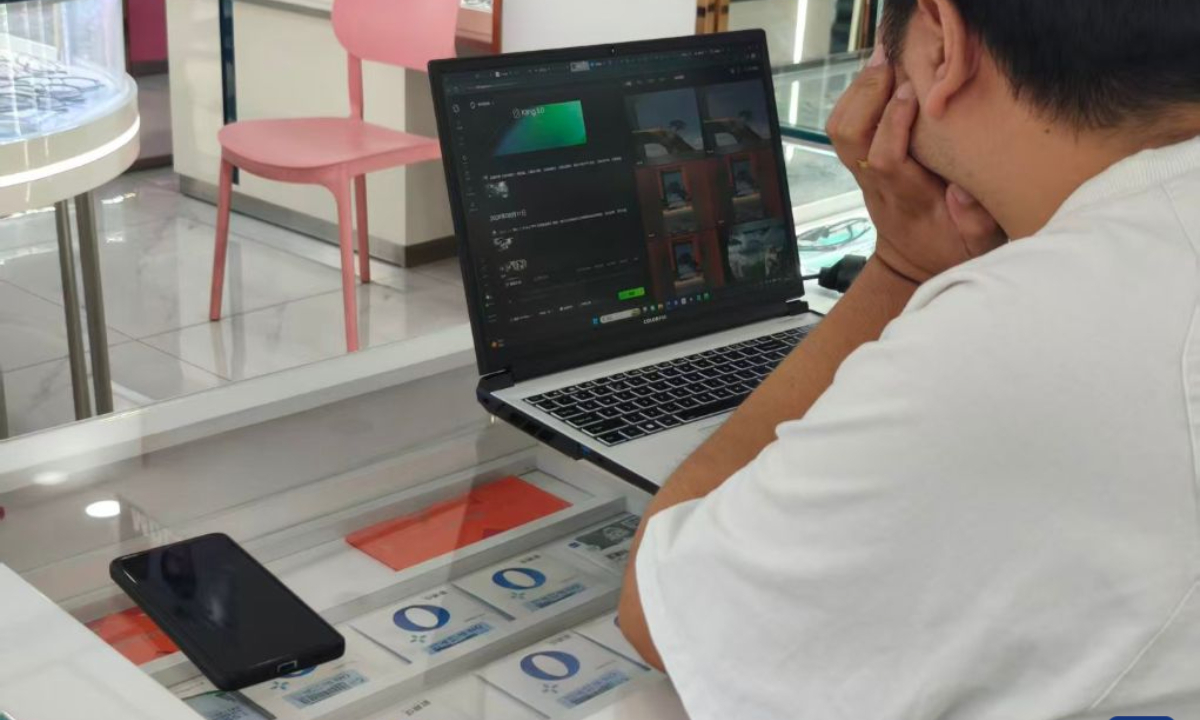
Chen Aijun, 34, is an optometrist in Chengdu, capital of southwest China's Sichuan Province.
By day, Chen leads a quiet, down-to-earth life in a neighborhood optical shop. Inside, he worked among eyeglass frames and optometry equipment. On his computer was another landscape entirely: cloud seas, immense palaces, flying cranes and figures in ancient robes.
Chen's heaven did not come from any single ancient text.
Growing up in the 1990s, he watched "Journey to the West" and later encountered "The Investiture of the Gods," xianxia (immortal heroes) novels and fantasy games. Those stories mixed over time with images of Chinese architecture and landscapes he saw online.
He has never visited nearby Mount Emei, and most of what he knows of Mount Huangshan's famous sea of clouds comes from videos.
What appeared on his screen was therefore not a reconstruction of one fixed mythological scene, but a world shaped by traditional stories already filtered through television, novels, games, the internet and his own memory.
For years, Chen had no way to make that world visible.
He never studied painting, design, photography or 3D modeling. After high school, he joined his parents' optical business and eventually took over the shop.
Generative AI changed the gap between imagining an image and possessing the technical skills to show it to someone else.
More than a year ago, Chen began teaching himself through free online tutorials. In September 2025, he started regularly posting AI videos, and a month later began experimenting with palaces floating above clouds. He has since published more than 200 videos.
The process, however, involves far more than entering a few prompts. The technology lowered the technical threshold, but it did not make the choices for him.
When creating Nantianmen, the mythical heavenly gate, Chen first defines the spatial rhythm and tonal hierarchy, pairing towering architecture and cloud seas with deliberately miniature figures to amplify the celestial realm's grand scale.
If the result does not match the picture in his mind, he tries again. He often generates over 1,000 images a day, revising a single scene repeatedly before moving on to animation, editing, color grading and music.
The machine can generate a thousand possible heavens. Chen still has to decide which one is his.
"AI-produced images can be soulless, and it takes human inspiration and aesthetic sensibility to endow works with warmth and vitality," he said.
Zhang believes Chen's experience reflects a broader shift brought about by generative AI. He said AI is giving people without conventional artistic training access to forms of expression that once required specialized skills. But what they create still depends on what they bring to the tool.
"A person's existing knowledge inevitably shapes how they use AI," Zhang said.
Chen brought his memories to the machine. Viewers abroad, in turn, brought theirs to the image.
"Everyone brings their own associations to these scenes," he said.
If his imagined world had to be reduced to three elements, he would keep clouds, architecture and people. The first two should feel immense, he said, while the last should remain small.
The details are culturally specific, but the visual effect is more immediate: tiny human figures dwarfed by vast clouds and monumental architecture. The responses suggest that viewers did not need to understand every cultural reference to find a way into the image.
Chen has no overseas social media accounts and learned that the video was attracting attention abroad only when friends sent him screenshots.
His life at the optical shop has changed little. He still checks eyesight and fits glasses when customers come in, then returns to his computer when the shop grows quiet.
He now hopes to make longer AI videos with fuller stories. He also wants to visit Mount Emei and, one day, Mount Huangshan.
For years, images of distant mountains and clouds reached Chen through screens. His imagined landscapes later traveled through screens to people he had never met.
Now he wants to see the real mountains and clouds for himself.
。
Current article:http://rtcihot.cuancuguanzhongnieqinyazhun.cyou/ue0u55/aq9dc4.html
Published on:10:12:28
 18号海南封关在即,A股谁受益?| 1215 张博划重点
 UFO科学家爆料:美国秘密基地藏了至少四种外星人!
 落实“抓两头带中间”模式形成基层党组织创新机制——兴城市党建引领凝聚全面振兴磅礴力量
 Readers’ Reflections: China’s innovation success is real global news, landing in the living rooms of Italian retirees who barely use a smartphone: Italian scientist
 Shams:勇士一年390万美元签约乔治·尼昂 常规赛大名单正式满员
 好久没动的股票账户显示休眠了,里面还有点钱,怎么激活恢复正常交易?必须去营...